


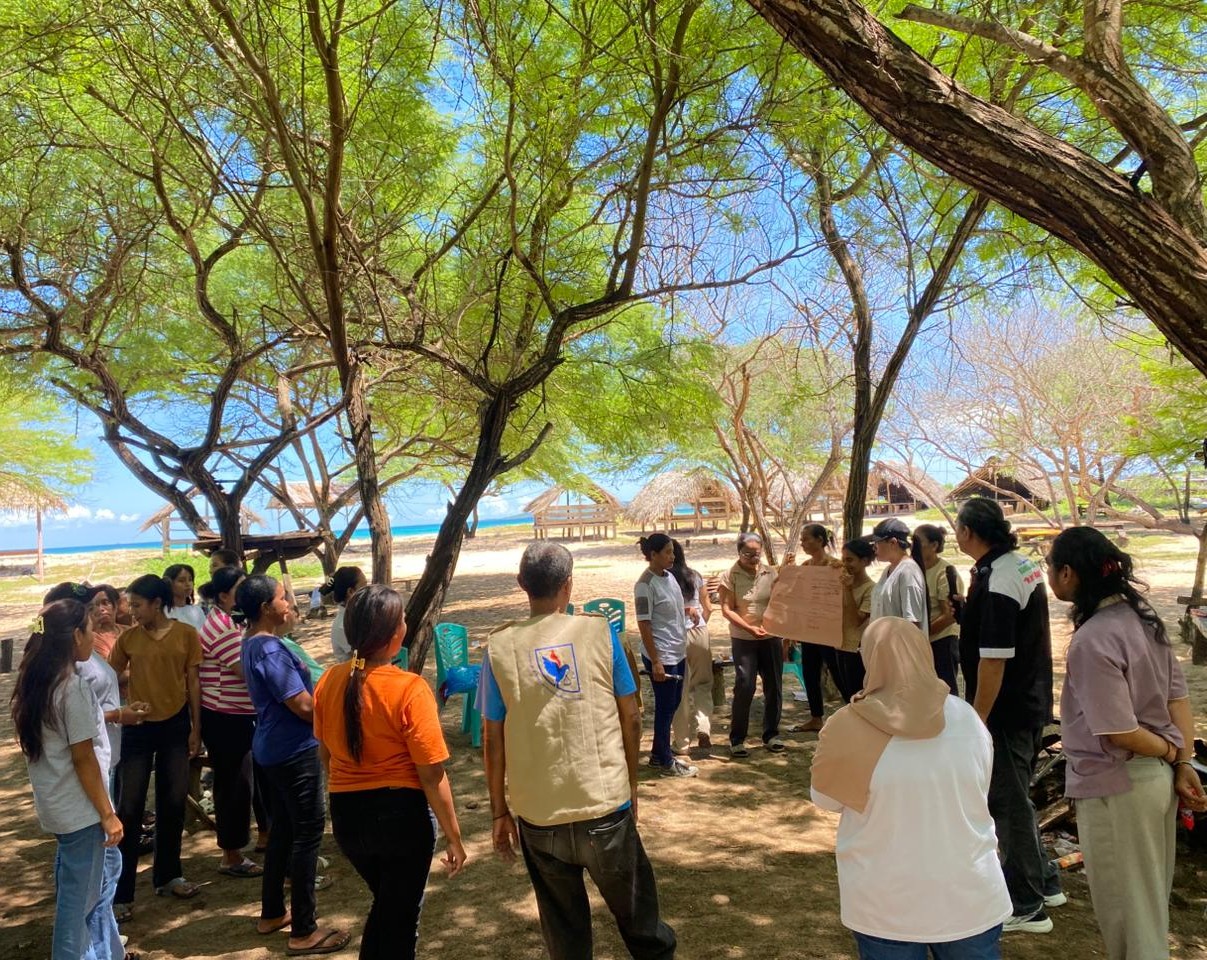
Oesina, April 10, 2026 – Loud applause echoed along the coast of Oesina Beach, Lifuleo Village. A group of women didn’t just sit and listen to lectures; they enthusiastically discussed and created chants about disasters. They were participants in a workshop and training program on participatory capacity building for women’s groups in disaster resilience and climate change adaptation.
The head of Lifuleo Village, Swingly Say, opened the event and encouraged all participants to take the training seriously so that the knowledge they gained would truly be useful. He reminded them that understanding both religion and the environment is very important for improving the quality of life in this free world. He also advised that the knowledge they gained should not be kept to themselves but shared with their neighbors as a form of cooperation in building better lives and families for the future. Because opportunities don’t come twice, he officially declared the training open.
The activity ran from morning until evening, facilitated by Haris A. Ch. Oematan, a disaster practitioner from Cis Timor, accompanied by a team from the Indonesian Justice and Peace Foundation (YKPI). The goal was simple: to encourage village women to not only be victims but also to become the front line in facing disaster threats.
Facilitator Haris Oematan deliberately avoided taking control. From the start, he emphasized, “The main speakers are all of you.” He only guided the process. With the sound of waves and coastal winds in the background, the women were divided into groups based on their hamlets. They were asked to define what a disaster means to them.
The results were powerful. A disaster wasn’t just an academic definition but a traumatic experience that left deep marks. One participant from Hamlet 1 said, “A disaster is something that happens suddenly, threatens our comfort, and causes deep trauma.”
The facilitator led participants to discuss what disasters had occurred and their impacts. Through intensive discussions, these women—who usually take care of households, garden, and cultivate seaweed—managed to map out the priority threats in their village. They chose three most threatening disasters:
- Strong winds or Cyclone Seroja: reminding them of the trauma from 2021 when houses were damaged and electricity was out for a month.
- Tidal flooding or high waves: every year damaging seaweed farming, the main source of income for the community.
- Pests and disease outbreaks: including crocodile attacks in the lake, monkeys destroying crops, and the spread of dengue fever and malaria.
One participant honestly admitted, “During Seroja, we could only pray and call on God’s name constantly. But after the disaster passed, sometimes we forgot.”
That statement became a turning point. The facilitator encouraged everyone not to rely only on prayer but also on real action.
The highlight of the event was the creation of a preparedness action plan, divided into three phases: prevention, response during disasters, and recovery.
- Prevention: The women proposed making emergency barriers from sandbags, replanting mangroves and “running grass” to prevent erosion, trimming tall trees that could easily fall, and spreading awareness about village conservation regulations.
- Response: When a disaster occurs, priority steps include evacuating to higher ground, sounding alarms by ringing bells, and bringing victims to health facilities.
- Recovery: Working together to clean up mud and garbage, repairing damaged houses, and replanting destroyed seaweed.
Lifuleo Village Head, Swingly Say, who had been present since the opening, gave his full support. He promised that the women’s group trained in this activity would be formally recognized through a Village Regulation (Perdes). They would receive an official decree (SK) and legal protection.
“This is not just a ceremonial event. I will include the disaster risk assessment and action plan in the Development Planning Meeting (Musrenbang). We will push for the village budget (APBDes) to accommodate it,” said Village Head Swingly.
Zarniel Woleka from YKPI closed the session with an optimistic message. “We have discussed two big issues: protection of women and children, and the environment. Let’s see which ones we can manage through village policies.”
This activity is part of a community organizing program by YKPI to strengthen the resilience of coastal women’s communities in East Nusa Tenggara. This article is adapted from the minutes of the workshop and training activity in Lifuleo Village on April 10, 2026.