


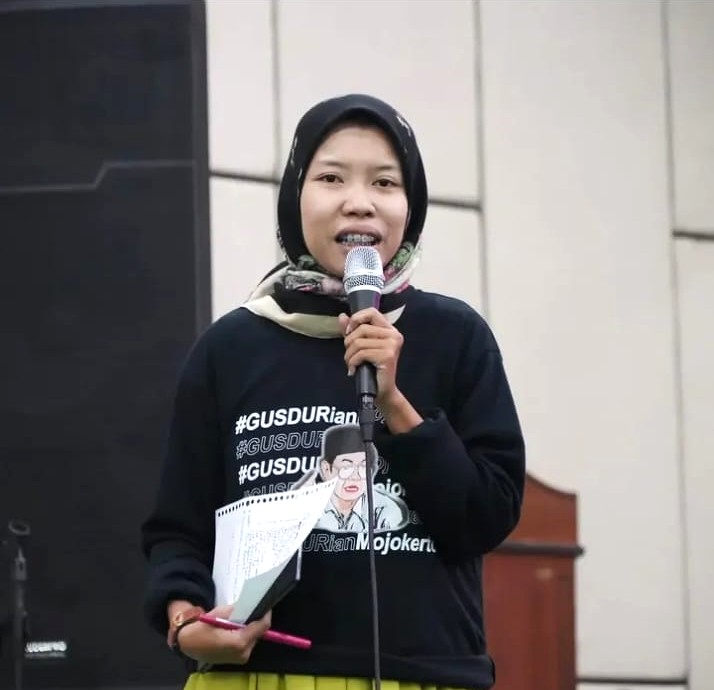
Behind every movement that grows from the grassroots, there are always personal stories that become the foundation of change. Those stories often do not appear in formal program reports, yet it is there that the true pulse of transformation beats.
Etika Nurmaya, affectionately known as Etika, is one of the activist cadres of Gusdurian Mojokerto who underwent a profound transformation in her journey of initiating Jagong Wadon. For Etika, the most meaningful change was not merely about having more activities; it was a shift in perspective on how spaces for women’s participation should be created. She realized that involving women especially at the grassroots level, could not simply be a matter of “inviting” them. Instead, they must be heard, valued, and given a safe space to speak.
Before the Story Begins: From Minutes-Taker to the Field
Before becoming actively involved in the initiation of Jagong Wadon, Etika was already familiar with the world of organizing as the Secretary of the Gusdurian Mojokerto Network. At that time, however, her role was mostly behind the desk.
“I really wanted to be directly involved in field programs. My activities were mostly indoors, drafting recommendations or handling case assistance from behind a desk,” Etika recalled.
The opportunity came when she was assigned as a note-taker in various Focus Group Discussions (FGDs). Even though she initially only took minutes, these moments of going into the field marked the beginning of her hunger for direct engagement with the community. Yet behind that enthusiasm, a sense of unease began to grow: Etika noticed how minimal women’s participation was in those strategic forums.
Recognizing the Need for a Dedicated Space for Women
The most significant change within Etika emerged through a series of long observations. She saw a troubling pattern: the women who were actively involved in organizations were usually those who already had a strong personal brand and established networks from other organizations they had joined before. Meanwhile, grassroots women, who were deeply engaged in movements and organizing but lacked formal “visibility”, seemed invisible and were often marginalized.
“The barriers can be patronage, or the stereotype that women can’t do anything,” Etika emphasized.
This unease hit a wall when she tried to invite more women to get involved. Her efforts were often misunderstood by patriarchal ways of thinking. “There were challenges where this initiative was seen as an attempt to build ‘my own wagon,’ when what I was doing was purely for organizing, so that women would have a platform to express themselves,” she said.
The realization that grassroots women possessed specific knowledge that was often overlooked became the starting point for Jagong Wadon. The name was first used in 2022 as part of the Forum 17-an (Indonesian Independence Day series), with discussions on tolerance and diversity that later evolved to create a dedicated space for discussing women’s issues.
Collaboration and Digital Adaptation
The transformation Etika experienced was supported by cross-gender collaboration. One of the strongest forms of support came from male colleagues, including a videographer who helped produce content. This spirit grew even stronger during the commemoration of the 16 Days of Activism Against Gender-Based Violence (16 HAKTP).
Although she felt disappointed that the government had not fully involved civil society networks like Gusdurian in the Musrenbang (development planning deliberation), Etika did not lose heart. Instead, she initiated the creation of a documentary film and a podcast to archive the stories of women that had long gone unheard.
“Gusdurian rarely documented its activities. So, the idea of a podcast emerged, so that the stories of our friends at the grassroots would not disappear and could become a valuable archive,” Etika explained.
Becoming a Bridge for Aspirations in Mojokerto
Today, Jagong Wadon has become a place where women in Mojokerto can entrust their hopes. Etika recalls a touching moment when she interviewed a mother, a survivor of violence who had to support four dependents by selling snacks.
“During the video shoot, she expressed her hope that her voice could reach the ears of policymakers, like the mayor’s wife. She wanted her struggle to be seen,” Etika recounted. This simple hope proved that Jagong Wadon had become a bridge for aspirations, for those who had long felt that formal channels were too distant to reach.
Hope for the Future: The Courage to Continue
For Etika, courage is the key. She hopes that what she started does not stop with her. “It’s impossible for me to keep doing this alone. I need other friends to collaborate with, not to compete against,” she stated firmly.
Etika Nurmaya’s story is a reminder that real change does not always come in the form of a grand, earth-shattering event. Real change lies in the everyday courage to create spaces where everyone—especially women—can say, “This is me, this is my voice, and this is my story.”
Editor’s Note: This article is part of the documentation of the Most Significant Change (MSC) story of Etika Nurmaya, an activist cadre of Gusdurian Mojokerto, written by Rose Merry based on an interview conducted on March 23, 2026.