


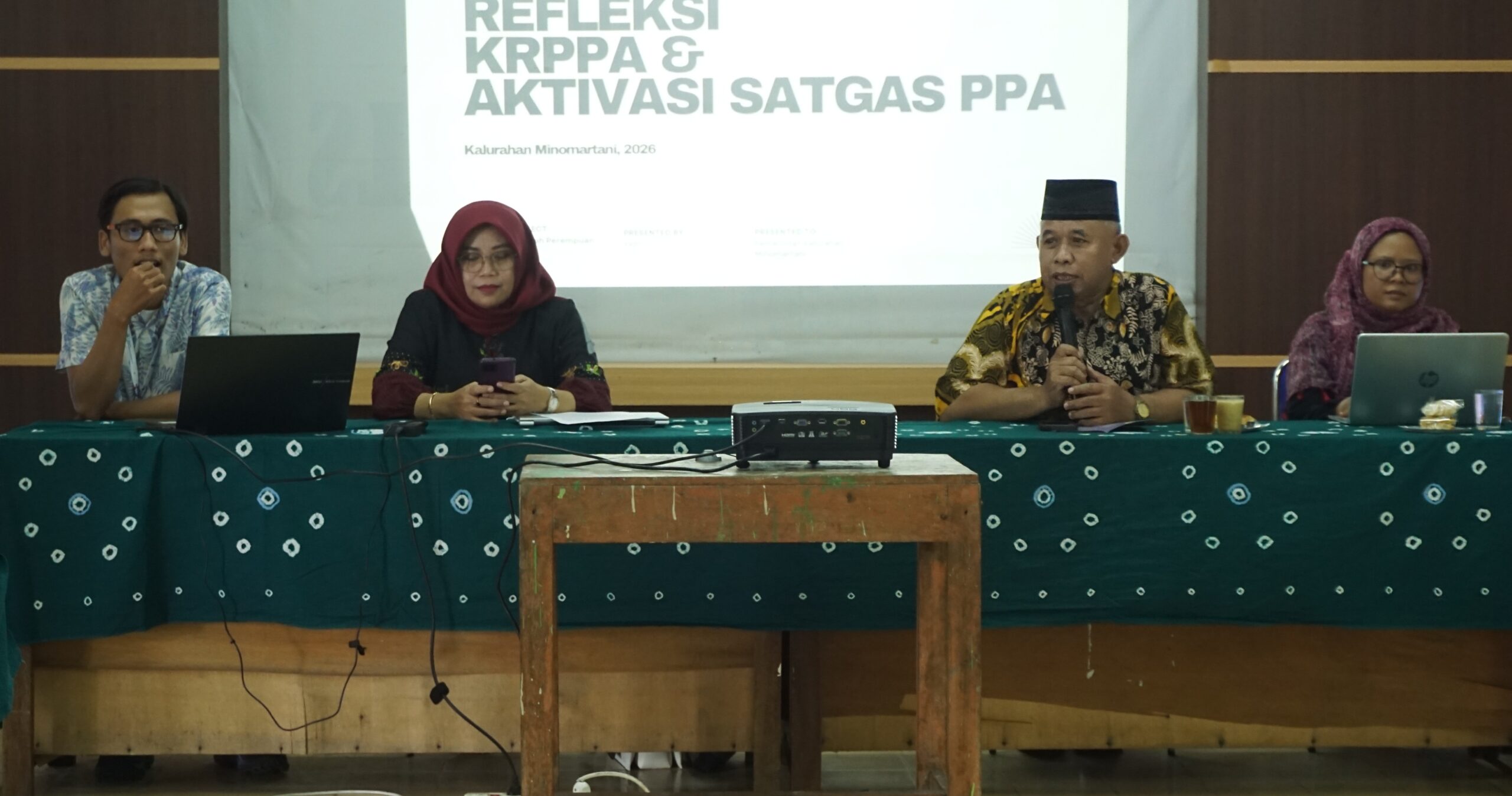
Minomartani, April 1, 2026 – In the midst of the still-strong Syawal atmosphere, dozens of residents, village officials, and facilitators from the Indonesian Women’s Welfare Foundation (YKPI) gathered. They were not merely engaging in a social visit, but carried a major mission: to form a responsive and sustainable Women and Children Protection Task Force (Satgas PPA).
The meeting, held on Wednesday (1/4), was a follow-up to the second previous meeting that had discussed cases of violence in the local area. This time, the main focus was to reactivate the structure of the PPA Task Force, which had previously only existed for competition purposes.
Hartono, the Kamituo (village deputy head) of Minomartani, opened the event with high hopes. He acknowledged that so far, the handling of women and children’s cases had been limited to the PKK (Family Welfare Empowerment) elements.
“Actually, a Task Force already existed before, but only for competitions. The structure that was formed had a chairperson, secretary, and treasurer, but it felt inadequate. Therefore, we ask those present to fully fill the PPA Task Force structure,” said Hartono.
Meanwhile, Kristina Viri, representing YKPI, energized the participants with a distinctive cheer: “Women-friendly, caring for children, and disabilities!”
“We are committed to supporting Minomartani Village to become a safe and inclusive place for vulnerable groups. Hopefully, all parties can be involved and each have their role,” Viri emphasized.
What is KRPPA? Creating a Safe and Inclusive Village
The core material was delivered by a speaker from the Office of Women’s Empowerment, Child Protection, Population Control and Family Planning (DP3AP2KB). This event was the second socialization, following a similar one on Father and Child-Friendly Village.
It was explained that the Women and Child-Friendly Village (KRPPA) is a program that integrates gender perspectives and children’s rights into village governance. The goal is to create a safe, inclusive, and violence-free environment.
There are at least 10 main indicators to be met, ranging from the availability of disaggregated child data, village regulations, to women’s representation in the Village Consultative Body (BPKal). Most importantly, there must be no violence against women and children, no child labor, and no marriage under the age of 19.
Heated Discussion: Child Marriage and Gender Equality
The question-and-answer session was the most dynamic. A participant, Mr. Tri, raised a realistic question: “Child marriage happens everywhere and is difficult to stop. If a pregnancy has already occurred, what is the solution? Religiously, a pregnant woman should not be married off.”
In response, the speaker from DP3AP2KB explained the legal-formal side. “From the Sleman Population and Civil Registration Office, the common step taken is to first marry according to religion and state so that the child born has a birth certificate bearing the names of both father and mother. After the child is born, a second marriage contract (ijab) can be performed to complete the legal aspect. However, the couple does not immediately live together until they come of age,” she explained.
A critical question also came from Giovani, a member of BPKal. He highlighted the importance of involving men in women’s empowerment programs.
“Don’t just give women the strength to fight back. Men must also be made to understand that women are life partners, not just ‘konco wingking’ (background companions). Because in reality, social power is still largely in men’s hands. If men are not educated, what happens is actually opposition,” Giovani stressed.
This statement was supported by Marjiatun, a resident who is also a Human Development Cadre (KPM). “I have two sons. I am used to teaching them about responsibility. Women are not objects. Don’t just tell women to protect themselves. Boys must also be taught great responsibility,” she said.
Domestic Violence Cases and the Impact of Social Media
Another equally interesting question came from Angga, a Family Planning Field Officer (PLKB). He recounted a case of child violence against parents that had been handled but showed no improvement. “What is the solution so that the family can become harmonious again?” he asked.
Additionally, he highlighted the negative impact of social media. Although there is a rule prohibiting children under 16 from having social media accounts, in reality, children can fake their age. “There have even been cases of cyberbullying leading to child suicide. Is there any guidance or deterrent effect?” he added.
Responding to this, Anik from DP3AP2KB explained that her office has a Technical Implementation Unit for Women and Child Protection (UPTD PPA) and PUSPAGA (Family Learning Center) that provide free counseling. “However, the key is family resilience. Problematic children usually come from disharmonious families, broken homes, or lack of attention,” she explained.
Root of the Problem: Vulnerable Relationships and Lack of Systematic Mechanisms
Rais, a community organizer from YKPI, presented the results of problem mapping in Minomartani. He showed that the root cause of violence against women, children, and people with disabilities is not singular.
“The core of the root problem lies in relationship vulnerability, especially family resilience. The next layer is the absence of systematic mechanisms for protection and fulfillment of rights. The outermost layer is the weak gender perspective and children’s rights,” Rais explained.
To address these three root problems, Rais introduced three main pillars that need to be strengthened: prevention, response, and recovery. All three must operate systematically and sustainably.
Participants were then divided into three discussion groups, each discussing strategies for prevention, accompaniment and advocacy, and recovery and empowerment. The results of the discussions were then presented and clarified together.
The meeting, which lasted from morning until noon, ended with optimism. Despite the challenges still being great—ranging from patriarchal culture, the influence of social media, to limited funds—the commitment to make Minomartani a village friendly to women, children, and people with disabilities is beginning to take a more concrete shape.
The PPA Task Force is no longer just a structure for competitions. It is expected to become the frontline capable of providing prevention, accompaniment, and recovery for survivors. And just as importantly, men and women will sit equally as partners, not as rulers and subordinates. Now is the time for the residents of Minomartani to realize this, not only in cheers, but in concrete action.