


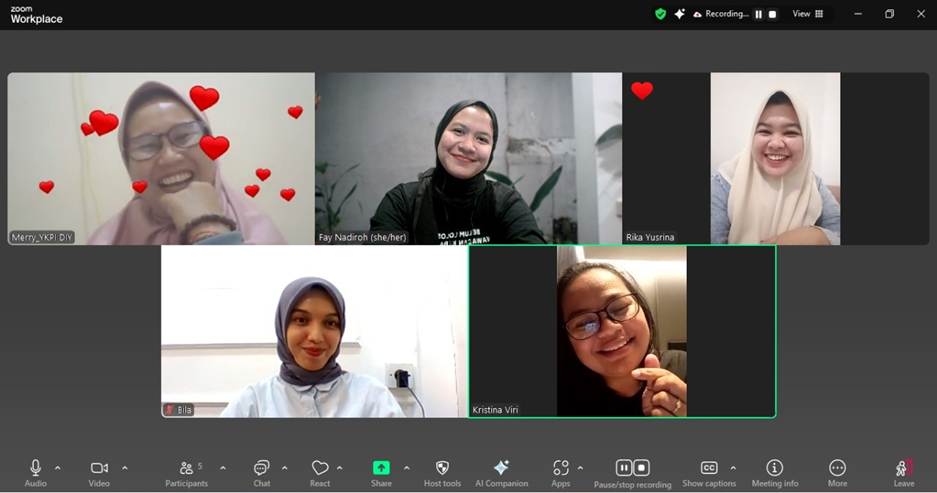
International Youth Day is about hearing their voices, the voices of young people, which are a call to action—a call to demand safe spaces, inclusive policies, and recognition of equal dignity. Change is not an illusion, but collective work. Are you ready to listen, speak out, and move together to realize a just Indonesia for all women?
This nation still often forgets almost half of its population: women. This shared anxiety brought together three young women from the tip of Sumatra to the heart of Java: Bila from Aceh, Rika from Pidie, and Fay from Yogyakarta, who are focal points in the AFSC Youth Network Global Indonesia. Their meeting was no coincidence, but a convergence of fates over the same injustice: a system and culture that neglects the experiences and needs of Indonesian women. From bitter personal stories, their discussions surged into the realms of policy, rights, and protections that remain fragile, far from guaranteeing a safe and dignified life.
A new wave of anxiety comes from the Revision of the Indonesian Military (TNI) Law passed in March 2025. More than 40 cities echoed with protests, rejecting the shadow of returning military dominance in civilian positions. For women, this is not just about power structures. It is about living spaces that are shrinking, voices being increasingly suppressed, and the unhealed wounds of past state violence. Grim records speak in the last four years, 190 cases of violence against women by TNI members were recorded. This law revision betrays an already fragile sense of safety.
Meanwhile, on the legislative table, the Domestic Worker Protection Bill (RUU PPRT) remains in limbo after being fought for over two decades. The irony is stark: most domestic workers are women, working in vulnerable conditions with almost no legal protection. The state’s neglect of domestic and care work, which is predominantly performed by women, feels like a form of systematic injustice. The value of their work continues to be ignored.
This anxiety is not abstract. It has a face.
Bila in Banda Aceh felt the direct impact of the curfew policy for women. Instead of protecting, the policy shackles women’s mobility and endangers those forced to work late at night to earn a living. This discrimination ignores the socio-economic reality that forces them to leave home after dark.
Rika, raised in Pidie, Aceh, was once not permitted to continue her education at university. The belief that a woman’s role is solely as a housewife severs access to education. Her experience with Flower Aceh opened her eyes: many women around her are trapped in child marriage and endless structural poverty.
Meanwhile, Fay in Yogyakarta highlights the layered vulnerabilities of women with disabilities. At her workplace, she witnesses how they face not only gender stigma but also disability barriers. The lack of access to information on Sexual and Reproductive Health and Rights (SRHR) makes them easy targets for sexual violence. Ignorance about their own bodies and rights weakens their self-protection.
Three Main Challenges Demanding Immediate Attention:
First, the shadow of child marriage still looms over Aceh. The period from January to October 2023 recorded 1,310 cases, with 96% of the victims being girls, doubling from the previous year. The revision of the Marriage Law, raising the age limit to 19, has not been potent enough to combat grassroots practices. The impact is clear: women who marry early are vulnerable to violence, reproductive health problems, school dropout, and perpetual economic dependence.
Second, the silence around reproductive health education persists. Many children do not know their own bodies. This lack of knowledge plunges adolescents into child marriage, unplanned pregnancies, or sexually transmitted infections. Comprehensive Adolescent Sexual and Reproductive Health and Rights (SRHR) education should be their first fortress to protect themselves and make life decisions consciously.
Third, the layered vulnerability of women with disabilities facing sexual violence. Data from the Center for Advocacy for Women, Disabilities, and Children (SAPDA) in Yogyakarta reveals how the lack of SRHR education makes them easy targets for sexual violence, often by those closest to them. Physical, psychological, and social barriers prevent them from reporting or accessing protection. This situation underscores the urgent need for truly inclusive and accessible SRHR services and gender-based violence protection.
However, amidst the challenges, points of optimistic light shine. Synergy among multi-stakeholders—from government, NGOs, communities, academics, to media—is increasingly strengthening, accelerating advocacy and building more responsive policies. Spaces for women’s participation at the village and government levels, such as the Musrenbang (Development Planning Meeting) forum, are starting to become available, though their utilization still needs to be improved. Civil society awareness, especially among the younger generation and grassroots communities, continues to grow, pushing cultural change towards gender justice.
Supporting regulations for women’s rights are also becoming more complete: The Sexual Violence Crimes Law (UU TPKS, No. 12/2022) protects victims of sexual violence, the Domestic Violence Law (UU PKDRT, No. 23/2004) protects from domestic violence, the ratification of CEDAW (Law No. 7/1984), the Child Protection Law (No. 23/2002), and the revision of the Marriage Law (No. 16/2019) which raised the marriage age limit.
The root of the problem, however, remains deep and layered: systemic patriarchal culture. This is evident both in patrilineal systems that subordinate women and in religious interpretations that are often misused to justify discrimination and violence. Discriminatory policies, like those in Aceh, worsen vulnerability. Women with disabilities experience a double layer of oppression: patriarchy and ableism, as seen in practices of forced contraception/sterilization in rehabilitation centers. The impact is social restriction, sexual violence, and massive economic disadvantages. Men, too, as part of society, are affected by this cycle of injustice.
The struggle for women’s rights is not merely a regulatory debate. It is about the recognition of their everyday lives. Change begins with acknowledging that women’s experiences are real, important, and worthy of being the foundation for building fair policies. The stories of Bila, Rika, and Fay serve as a mirror to reflect on what remains flawed and what can be improved.
At the very least, voice your concerns to become part of the movement fighting injustice. Join networks, push for progressive policies, and be part of the solution. An equal future begins with the steps of young people today.
Article written by Rose Merry, referring to the Context Analysis document of the Youth Network Q1 2025 compiled by Bila, Rika, and Fay.