



Yogyakarta, December 10, 2025 – Women affected by the floods and landslides in Aceh and Sumatra are identified as the community group bearing the heaviest disaster risks and most vulnerable to potential violence in disaster areas. Violence against women in Indonesia surged by 41% in the last two years, according to 2024 data from the National Commission on Violence Against Women (Komnas Perempuan). This spike is driven by complex factors, ranging from culturally-based violence like bride kidnapping (kawin tangkap) to structural policies that increase women’s vulnerability.
Women in Aceh and Sumatra have become victims of environmental governance failures that led to the major floods. Farah from the Banda Aceh Legal Aid Institute (LBH) emphasized that in every disaster, women are always the most impacted yet most invisible group. Data shows a recurring trend since 2020: violence against women and children increases significantly during disasters. That pattern is confirmed again today. Amid the emergency response, LBH is handling a case of sexual harassment against a female university student seeking safe shelter—a clear proof that gender-based violence intensifies during crises.
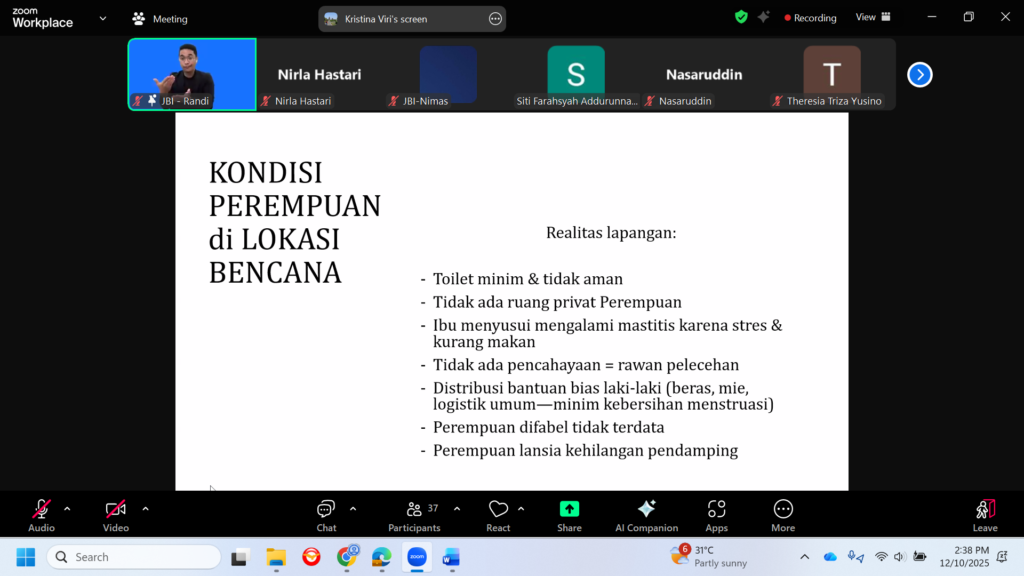
Women, although often absent from official data, bear the heaviest burden. They are forced to drink floodwater, fear using dark bathrooms risking urinary tract infections, and lack basic necessities like sanitary pads. Breastfeeding mothers, pregnant women, persons with disabilities, and the elderly are increasingly neglected.
Patriarchal culture exacerbates the situation. The specific needs of women are considered unimportant, even once ridiculed by men when women’s underwear was included in aid packages. The domestic burden continues to weigh on women, while their involvement in decision-making is minimal. The trauma of the Aceh conflict is also reawakened by the presence of security forces and the sound of helicopters.
Farah called out: “The voices of Acehnese women must be heard. Disaster management must be gender-sensitive, from psycho-social services, safe spaces, to fulfilling women’s specific needs. Disaster is no excuse to allow violence and injustice to repeat.”
Titled “Indonesia in the Vortex of Emergency Violence Against Women: Unraveling Structural Violence,” this webinar featured field practitioners from three high-risk areas: Farah from LBH Banda Aceh, reporting on the double vulnerability of women flash flood victims and the progressive revision of the Qanun Jinayat; Yustina Damadia from SOPAN Central Sumba, explaining efforts to eliminate bride kidnapping practices through customary agreements; and Lola Fernandes from CIS Timor, highlighting interfaith conflicts in border areas and the key role of women in peacebuilding. The media perspective was presented by Bhekti from the Alliance of Independent Journalists (AJI) Yogyakarta, who criticized news coverage that often obscures the root causes of violence.
The 2024 Komnas Perempuan data referenced in the discussion shows the complexity of the issue: from a total of 330,097 cases, violence in the personal/domestic sphere (DV) still dominates (309,516 cases), followed by the public sphere (12,004 cases) with Online Gender-Based Violence (OGBV) being the most prevalent. Violence trends also span vulnerable groups such as women with disabilities, sexual minorities, and indigenous women.
Lola (CIS Timor) conveyed that “women and children are the most vulnerable groups in conflict. Bureaucratic challenges, cultural structures, and difficult community environments also arise, such as feelings of being threatened when women become more vocal.”
The same sentiment was felt by Yustin from SOPAN Sumba, “The strong patriarchal socio-cultural structure. Certain practices (like bride kidnapping) are justified in the name of tradition, restricting the space for women and children. Victims who report violence are considered rebels.”
“The issues in Sumba, Aceh, or the border areas share a common thread: patriarchal culture reinforced by unfair systems and policies. The media must dare to probe into the heart of this problem, not just report chronologies,” asserted Bhekti (AJI Yogyakarta).
This webinar is the culmination of the 16 Days of Activism Against Gender-Based Violence (16 Days) campaign and the 2025 Human Rights Day commemoration by YKPI, aiming to strengthen advocacy networks and encourage public participation, including journalists and youth, to build a victim-centered peace narrative.
Contact Person: Program Coordinator Indonesian Justice and Peace Foundation (YKPI) l Kviri@ykpindonesia.org