


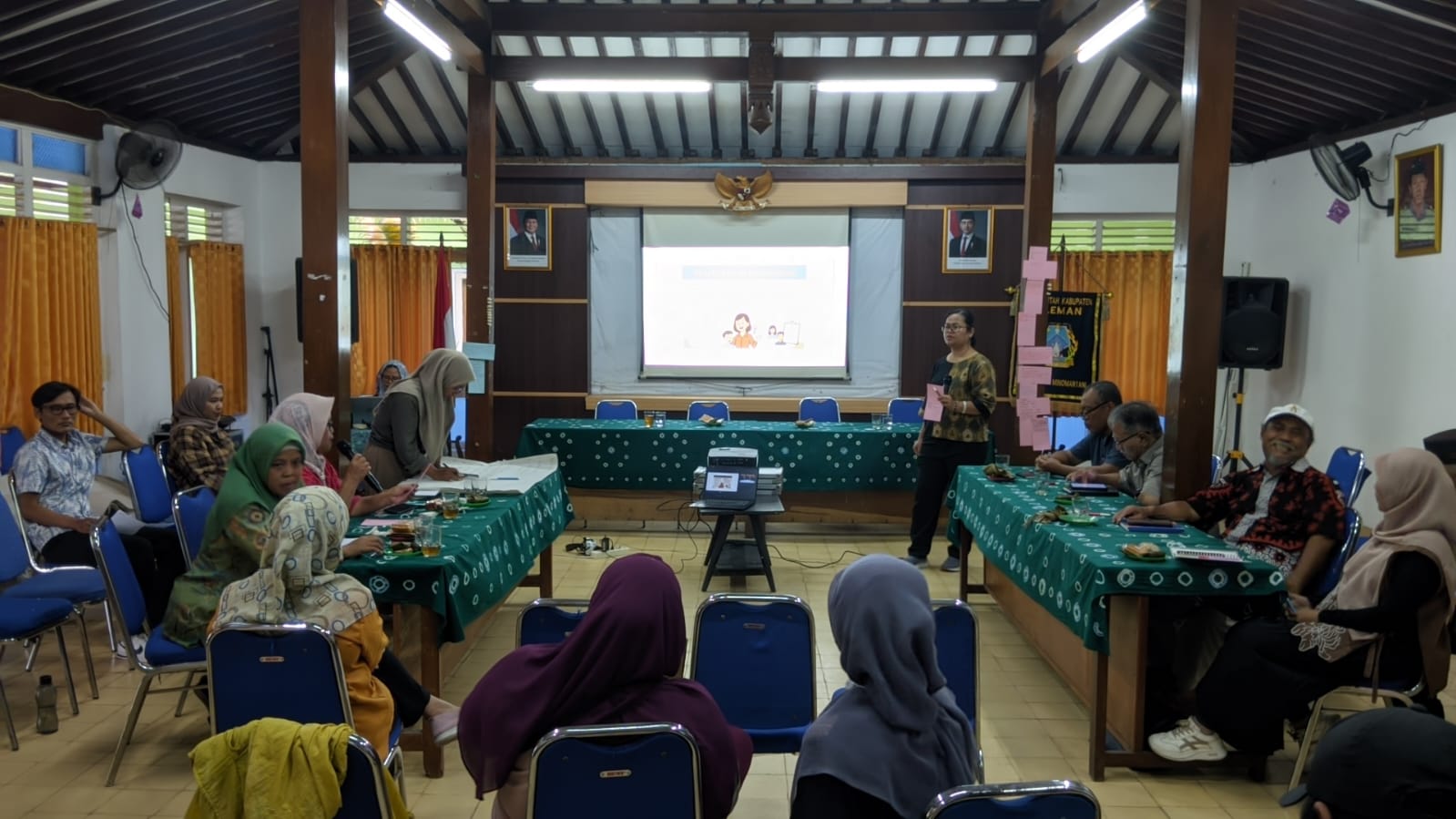
Sleman, January 29, 2026 — The Indonesian Justice and Peace Foundation (YKPI), in collaboration with the Minomartani Village Government in Sleman, Special Region of Yogyakarta, organized a Focus Group Discussion (FGD) on Problem Mapping as part of a village organizing area assessment. This activity serves as an initial step to understand social dynamics, map existing issues, and formulate strategies for strengthening the protection of women, children, and vulnerable groups at the village level.
The FGD was attended by various community elements, including village officials, the Village Consultative Body (BPKAL), Youth Organization (Karang Taruna), PKK (Family Welfare Empowerment) cadres, the Community-Based Health Program (WKSBM), community leaders, and resident representatives from Plosokuning 5 and 6, as well as Tegalrejo. This multi-stakeholder presence demonstrates a shared commitment to building a more inclusive and just village.
A Space for Dialogue and Community Participation
In his opening remarks, a representative of the Minomartani Village Government emphasized that the FGD provided a crucial platform for residents to voice problems faced in their respective areas. “Through this forum, issues from each hamlet can be conveyed and discussed together to find solutions,” he stated.
YKPI, as the facilitating partner, stressed that the problem-mapping process aims not only to identify issues but also to strengthen the community’s capacity in formulating solutions. “This FGD serves as a shared learning space to see problems more holistically and seek concrete steps that can be taken collaboratively,” said a YKPI representative.
Key Findings: Prevailing Issues
The participatory discussion revealed several main issues still faced by the Minomartani community.
First, issues of power dynamics within families and child-rearing patterns. Several participants noted that communication between parents and children remains dominative. “The way children are treated is still dominant, not fully child-friendly,” revealed one FGD participant.
Second, cases of domestic violence (KDRT), harassment, and family conflict. Village representatives conveyed that such cases still occur, although they are not always reported. “Cases of domestic violence and harassment exist, both directly and through social media,” they said.
Third, issues of early marriage and child exploitation, impacting school dropout rates and social vulnerability. “There are children who marry early and therefore do not continue their education, and child-rearing is instead done by grandparents,” said a representative from the Youth Organization.
Fourth, the vulnerability of the elderly and mental health issues. Some elderly live alone without family support, while cases of People with Mental Disorders (ODGJ) indicate a lack of family support in the recovery process. “Many elderly live alone because their children are out of town, so neighbors manage their needs,” shared an FGD participant.
Fifth, challenges in implementing village policies. Participants highlighted that village regulations on being women- and child-friendly have not been accompanied by adequate budgeting and socialization. “Regulations exist, but they are not yet budgeted for, so they are not running optimally,” said one participant.
Strengthening Village Institutions and Collaboration
In addition to mapping problems, the FGD also served as a space for reflection on the role of village institutions, including the Task Force for the Protection of Women and Children (PPA). Participants assessed that the PPA Task Force needs strengthening, both in terms of capacity, working mechanisms, and budgetary support.
The discussion also affirmed the important role of Neighborhood (RT), Community (RW) units, PKK, Youth Organizations, WKSBM, and other village institutions in preventing and handling cases. The involvement of local communities is seen as key to ensuring the protection of women and children does not stop at the policy level but is implemented in daily practice.
Initial Steps Towards a Women- and Child-Friendly Village
The problem-mapping FGD in Minomartani is an initial step towards formulating a village organizing agenda that is more responsive to the needs of vulnerable groups. The results of this discussion will form the basis for YKPI and the Minomartani Village Government in developing capacity-building programs, policy socialization, and the development of community-based protection mechanisms for women and children.
Through collaboration between the village government, community institutions, and residents, Minomartani is expected to develop a model village that is friendly to women, children, the elderly, and persons with disabilities, while also strengthening the practice of social justice at the local level.
For further information regarding the village organizing program, the public can contact the Indonesian Justice and Peace Foundation (YKPI) through:
• Email: office@ykpindonesia.org
• Social Media Account: Instagram @ykpibinadamai
• Phone: 0274 – 5049018