


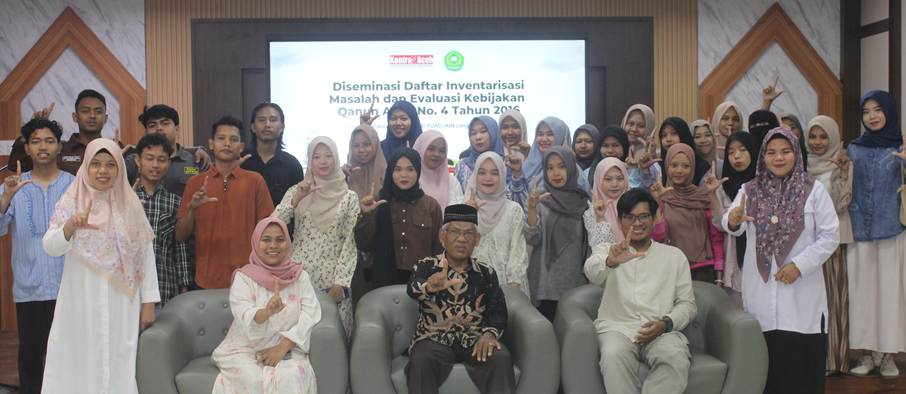
Aceh Qanun Number 4 of 2016 concerning Guidelines for Maintaining Religious Harmony and the Establishment of Places of Worship is nearly a decade old since its enactment. This regulation, originally intended to foster harmony and resolve conflicts, such as the 2015 Aceh Singkil incident, is now considered to have created new problems .
This Qanun, which replaced Governor Regulation No. 25/2007, was designed to guarantee the constitutional rights of every religious adherent. 2022 data from the Ministry of Religious Affairs illustrates this diversity, noting the existence of 4,408 mosques, 189 Christian churches, 20 Catholic churches, 12 Hindu temples (pura), 22 Buddhist temples (vihara), and 25 Chinese temples (klenteng) in Aceh.
However, in practice, this Qanun is deemed ineffective and tends to complicate the process of establishing places of worship. The main complaints come from non-Muslim communities due to complex requirements, such as gathering support from non-users of the proposed facility. Alarmingly, not a single non-Muslim place of worship has successfully obtained a permit since this Qanun was enacted .
The issues are not only inter-religious. Ironically, internal rejections have also occurred among Muslims, such as the case involving Muhammadiyah in Sangso Village, Bireuen. The lack of clear regulations for Muslim places of worship within the Qanun has further complicated resolutions .
As a vital legal instrument, the Qanun should uphold the principle of ‘majority rules, minority rights’. It must not be perceived as an arena for one group’s victory. If maintained in its current form, this Qanun has the potential to deepen injustices and render the citizenship rights of minorities as ‘Dormant Citizenship’—existing in law but unable to be realized .
Revision Recommendations for an Inclusive Future
Based on these concerns, KontraS Aceh urgently calls for the evaluation and revision of the Qanun. These recommendations were compiled through a List of Inventorized Problems (Daftar Inventarisasi Masalah – DIM), sourced from inputs from various stakeholders via Focus Group Discussions (FGDs). The following are the 9-point revision recommendations:
- Guaranteeing Justice and Equality: Revise Article 19 to apply identical and equitable requirements for establishing places of worship for all religions, without discrimination .
- Clarifying Definitions and Terminology: Add clear and measurable operational definitions for all key terms in Article 1 (General Provisions) .
- Simplifying Licensing Processes: Streamline bureaucratic procedures and reassess the rationality of the community support requirements, including considering the needs of congregations across village (gampong) boundaries .
- Integrating Inclusivity Principles and Technical Standards: Explicitly mandate principles of disability accessibility, gender responsiveness, disaster safety, and environmental friendliness into the technical building standards.
- Strengthening Dispute Resolution Mechanisms: Revise Article 26 to establish clear resolution stages: deliberation (musyawarah), mediation by a strengthened independent team, and clarity of legal procedural pathways in courts. Strengthen the role and impose sanctions for negligent local governments .
- Enhancing Synchronization with Spatial Planning: Emphasize the obligation for Building Permits (IMB)/Building Approval (PBG) to comply with the Regional Spatial Plan (RTRW) and Detailed Spatial Plan (RDTR).
- Regulating Temporary Permits: Add a chapter or article regulating a clear mechanism for temporary permits for the use of non-worship buildings.
- Strengthening the Role and Capacity of FKUB (Forum for Religious Harmony): Expand the FKUB’s mandate to include mediation and advisory functions, extend the tenure of its management, and guarantee adequate resource support .
- Oversight and Implementing Regulations: Develop a mechanism for monitoring the Qanun’s implementation and promptly issue derivative regulations (e.g., a Governor’s Regulation) to detailed technical matters .
Revision of Aceh Qanun Number 4 of 2016 is not merely an option but a necessity to realize its ideals as a fair, inclusive, and effective instrument for maintaining religious harmony. The recommendations proposed in this policy brief, which are evidence-based and sourced directly from community aspirations, are hoped to serve as a foundation for the Aceh Government and the Aceh House of Representatives (DPRA) to undertake substantial improvements. The implementation of a revised Qanun will significantly contribute to strengthening social harmony, preventing conflicts, and most importantly, upholding the constitutional rights of all citizens in Aceh Province.
This article was prepared based on the “Policy Brief: Evaluation of Aceh Qanun Number 4 of 2016 for the Establishment of Just and Inclusive Places of Worship” by KontraS Aceh. For further information, please contact: https://www.instagram.com/kontras_aceh/