


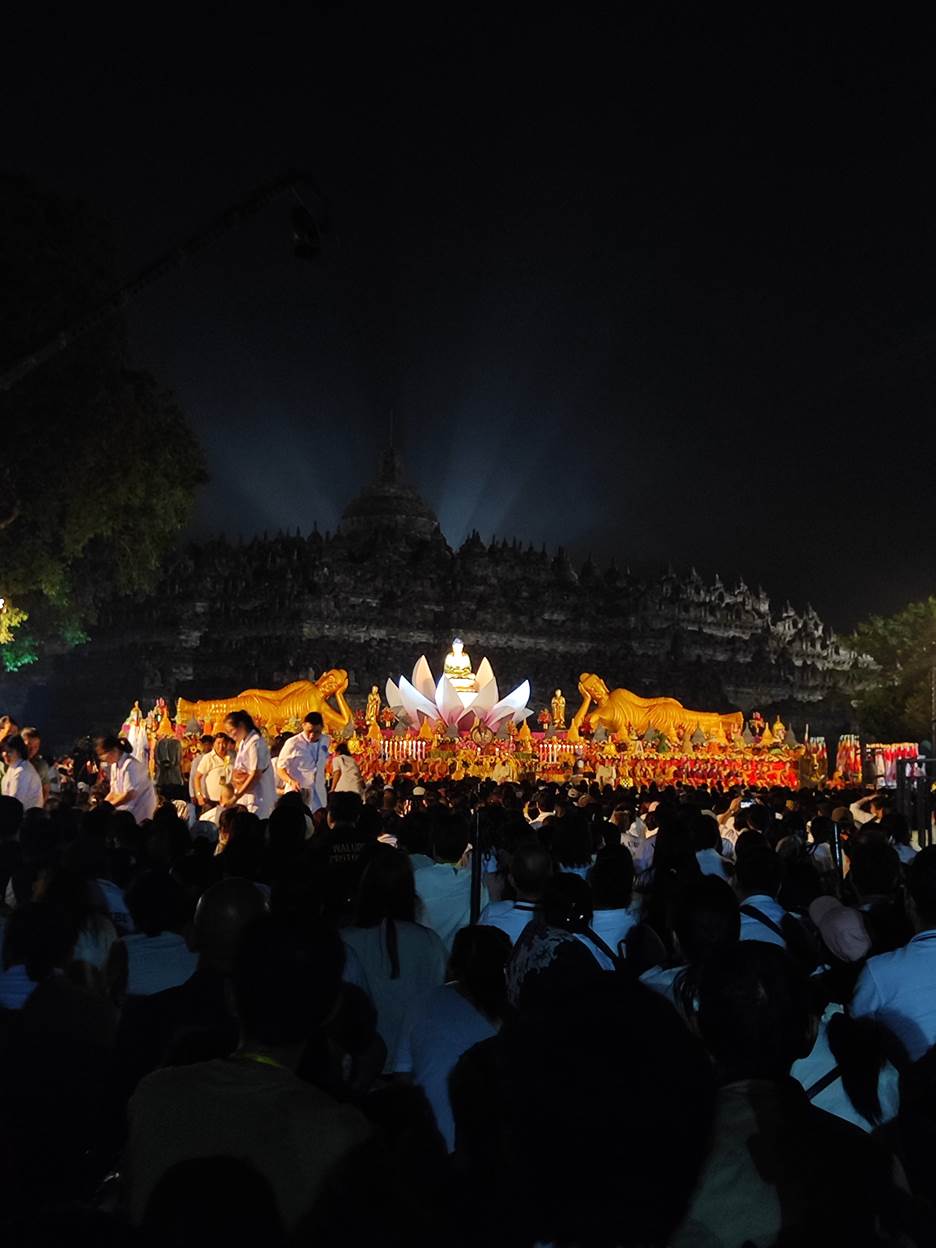
I want to share a little bit of a memorable experience on May 12, 2025, yes, right on Waisak Day. For me, this is not just a holiday or an ordinary ceremonial moment. This is a spiritual moment that I have been waiting for a long time. Since 2021, I have had a great desire to celebrate Trisuci Waisak at Borobudur Temple. At that time I still felt that this dream was far from reality, but finally, in 2025, that wish came true.
I started everything with intention and determination. Since the beginning of March I have started planning, looking for information from the Instagram account @waisak.nasional about how to celebrate it in Borobudur. Because I am studying and interning, I have to be smart in managing time and logistics, especially since I live in Bandung, quite far from Magelang.
From year to year, the Waisak celebration in Borobudur has always been in the spotlight. One of the most awaited things is the lantern flight. But as a Theravāda disciple of the Buddha, I know that the essence of Vesak is much deeper than just lanterns. Unfortunately, in practice, that is sometimes overlooked.
Before the event, I found out about the ID Card. It turned out that there were two types: zone 1 and zone 2. Zone 1 was specifically for Buddhists from the assembly under the auspices of WALUBI. Meanwhile, I, who was guided by Sangha Theravāda Indonesia, was not part of WALUBI and could only get access to zone 2. Initially, the plan was for only me and my close friend to go, but in the end, there were 13 people in the group
Honestly, I had doubts after my friend said, “If you go to Borobudur, it’s better to go during Asadha, the Puja will be more pronounced.” But I continued anyway. After joining the Waisak coordination group, unfortunately, the information I got was confusing. The group was more often used for buying and selling accommodation and trips, not coordinating events.
It started to feel chaotic on the day of the ID Card collection. It was not coordinated, the committee seemed to not know much about the event. I asked about the lantern flight, but they were confused. Even the ID Card was not ready when the collection time had passed. On the peak day, the schedule in the group and Instagram were not in sync, and road closures were not clearly informed. We were stuck in traffic and had to go around looking for a way.
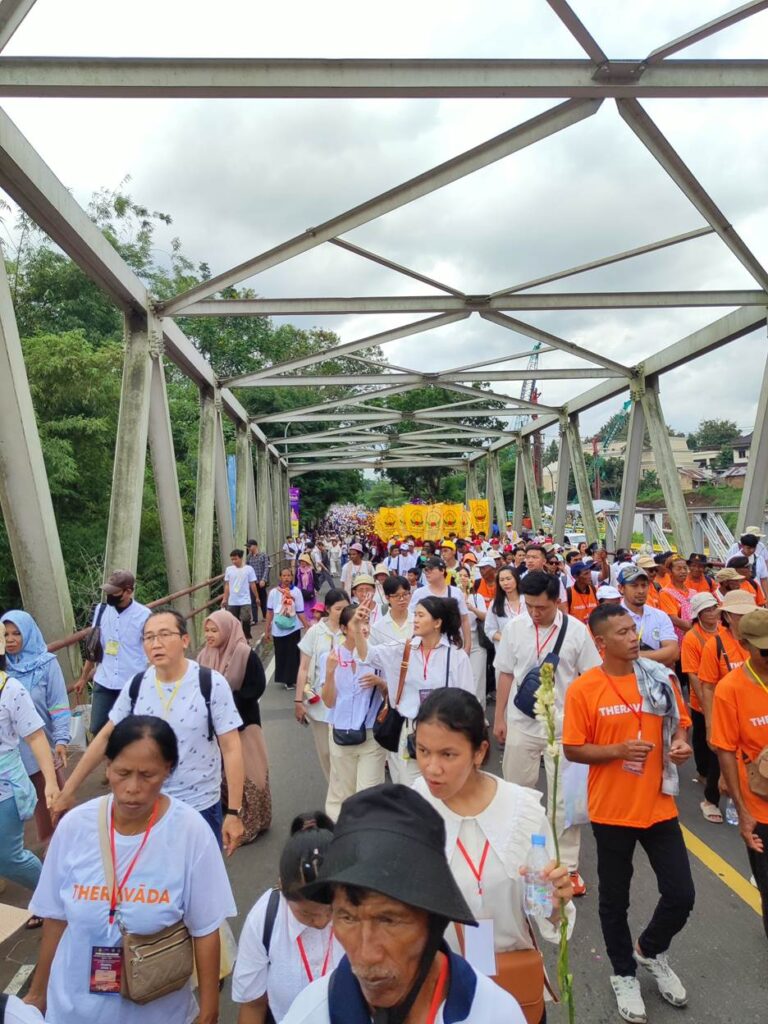
The most disturbing thing was during the procession from Mendut Temple to Borobudur. There was no clear line for the public, and the event was very unorganized. There were sick people who needed medical help, but the committee only provided an ambulance without a medical team. Imagine if the situation was critical, this could be very fatal.
Once we arrived at Borobudur, the atmosphere was not well organized, it seemed strange where many congregations had their own tents and altars, even though there was already a large altar in zone 1. It didn’t feel like a single unit. Many Buddhists who really wanted to worship couldn’t enter zone 1. Some even said that the zone 1 ID Card could be obtained by “donating” a certain amount, even though it was clearly written that the ID Card was free and not for sale. The funny thing was, many other congregations were actually in zone 1, while Buddhists were outside the main altar. Ironic, right?
There was even a friend of mine on the committee who offered a Zone 1 ID Card for Rp100,000, he said the real price was Rp1 million! Others said that the ID Card could be obtained by buying hanging lanterns or donating using digital DANA. But why is there a price for “funds”? Shouldn’t it be voluntary? This becomes a sale and purchase, not a paramita fund.
The saddest thing for me was seeing the fact that most of the people there didn’t really come to commemorate Waisak Day, but to watch the lantern flight. Again, it wasn’t actually their fault either. But the true meaning of Waisak was overshadowed by the glitz of the “festival”.
The lanterns were indeed made more environmentally friendly, but still, there was no guarantee that they weren’t really polluting. In previous years, these lanterns had also been an environmental problem. Not to mention Buddhists who came just to “follow along”, weren’t focused during the puja, and some even left after the lantern session was over, even though the event hadn’t ended. Only about 1,000 out of a total of 16,000 participants remained to participate in Dhamma Desana, Meditation, and Pradaksina.
This made me wonder, is this a celebration of the Holy Day of Vesak or even a “National Lantern Flying Festival”?
In fact, the meaning of Vesak is so deep: it commemorates three important events in the life of Buddha—his birth, enlightenment, and death. On that day, we should reflect on the teachings of love, peace, self-introspection, and ethics. But all of that seems to be overshadowed by the euphoria of tourism and uncontrolled crowds.
Nevertheless, I am still grateful. The dream I have harbored since 2021 has finally come true. There were indeed many shortcomings: from unclear information, miscommunication, drama, to issues of hidden capitalism. But I believe, this experience is still valuable. Hopefully in the future it can be better. Thank you to myself who has tried, to all beings who support, and to all the committees who have worked hard.
Finally, Sabbe Satta Bhavantu Sukhitatta—May all living beings be happy.
“What about you? Have you ever had a similar experience? Or do you have a different Waisak story? Share it in the comments!”
Author: Dhammara Aditya Kusnandar, Alumni Temu Keberagaman YIPC (Bandung)