


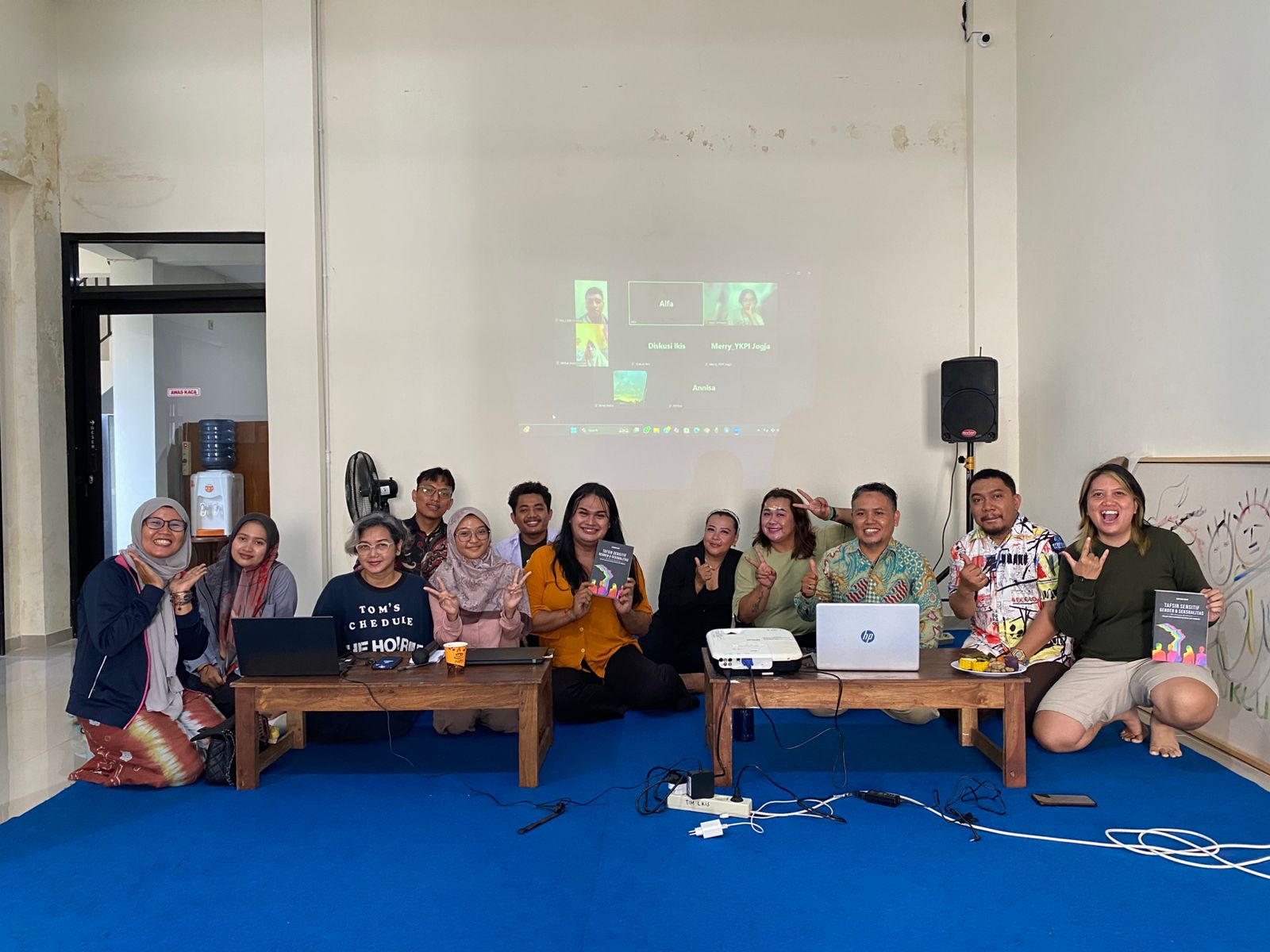
On Thursday, May 8, 2025, Youth Accros Diversity interns of the Indonesian Justice and Peace Foundation (YKPI) together with the Institute for Islamic and Social Studies (LKiS) held a book discussion aimed at opening up a dialogue space on gender and sexual diversity within a religious framework. This activity featured a book by Arif Nuh Safri entitled Sensitive Interpretation of Gender & Sexuality: Building an Inclusive Bridge for Non-Normative Religious Groups. Arif Nuh Safri is a researcher, writer, and lecturer in Al-Quran and Hadith Studies and Tafsir and Hadith at the Sunan Kalijaga State Islamic University in Yogyakarta, and has published many books, one of which is the book that will be the theme of our discussion at this event. This discussion is not only a space for exchanging ideas, but also a place for joint reflection on how religion can be present in a more humane and just manner for all groups.
Ustadz Arif opened the discussion with wisdom. He expressed his gratitude for the opportunity given to share his concerns and hopes through the book he wrote. This book, according to him, was born from the desire to improve and complete his previous work which was felt to not provide enough space for a more friendly perspective on differences. He wanted to present an interpretation that did not close its eyes to social reality, and could answer the problems faced by many people today. One of the most touching things was his statement that diversity is not something that should be rejected or fought. As long as no violence is caused, differences need to be celebrated as part of humanity. Religion, he continued, should be a solace, not a source of fear. It should be present as a shelter, not a weapon to judge or hurt others.
In the discussion, various layers of conflict faced by non-normative groups were also discussed. Starting from the inner struggle of individuals, pressure from family, rejection from society, to the stigma formed by the media and the state system. Even religion, which should be a protector, often perpetuates wounds through narrow interpretations and closes off space for dialogue. We are invited to realize that not everything we have considered right so far is based on justice. One of them is the matter of the terms “Sodomy” and “Homosexual” which are often equated. In fact, the two are fundamentally different. Homosexuality is related to orientation or emotional and inner attraction to the same sex, while sodomy refers more to sexual acts or behavior. Even in the story of the Prophet Luth, Ustadz Arif invites us to look back at the context that the core of the problem may not be about orientation, but rather a form of violence against the weak and fear of immigrants.
One of the most powerful messages from this discussion is the importance of being careful in reading and understanding the holy text. The Qur’an is not just a collection of sentences to be read literally, but has a depth of meaning that requires an understanding of the social, cultural, and historical context. Interpretations that do not take context into account can be misleading and used as a justification for oppressing certain groups. This is where the importance of rereading, reinterpreting, and cultivating a more compassionate understanding lies. From what Ustadz Arif said, we learn that humanity and religion should not stand at odds. Both can strengthen each other if we are willing to open our hearts and approach them with empathy. We do not need to be afraid of differences if we are able to see humans as fellow creatures of God, each of whom deserves to be heard and respected.
We are also invited to realize that the interpretation of sacred texts is always open to re-examination. It is not something frozen and unshakable, but can continue to develop along with the growth of our awareness of the values of justice and compassion. Precisely by opening up that space, we keep religion relevant and do not lose its basic meaning as a blessing for the universe. This discussion is a reminder that empathy is an important foundation in building a more just society. Being different is not a sin. Everyone, with all their uniqueness, has the same right to be loved, appreciated, and protected. Justice will not be born from a verdict, but from the courage to be present and listen fully. And finally, we are also reminded that big changes do not always have to start from big places. Sometimes, change begins in simple spaces like this from honest conversations, from critical questions, and from our willingness to break down walls of prejudice and build bridges of understanding. This discussion may be just one small step, but it can be a stepping stone towards a future that is friendlier for all.
Author: Ahmad Fatoni_Postgraduate Student of UIN SUKA YK, Internship participant of Youth Accros Diversity YKPI