


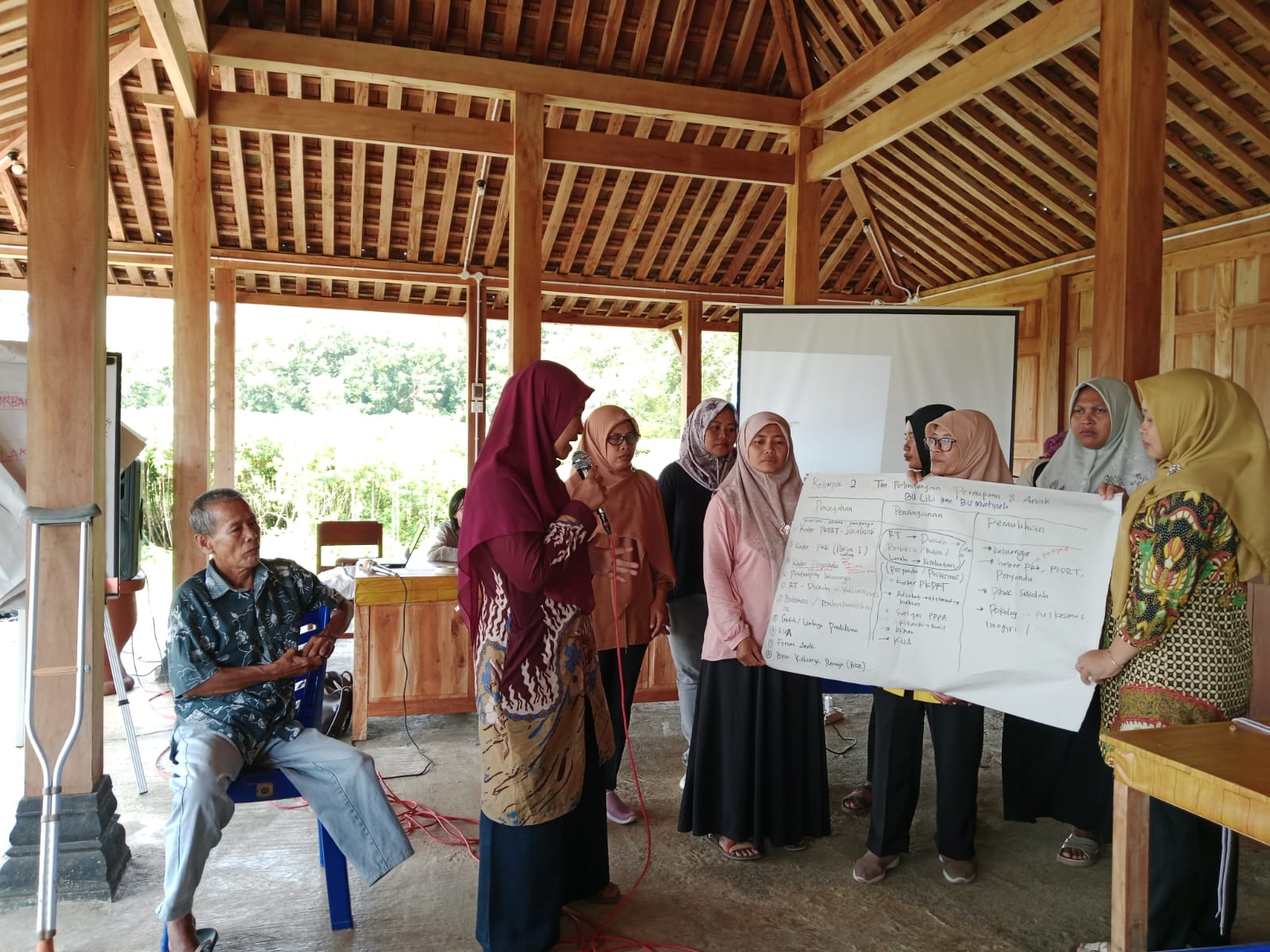
Sriharjo, Bantul — Residents of Sriharjo Village, Bantul Regency, strengthened the community’s role in preventing and addressing violence against women and children through a discussion and joint learning activity held at Lumbung Mataram Sriharjo, Friday (1/31/2026).
This activity, organized by the Indonesian Justice and Peace Foundation (YKPI), involved members of the Family Welfare Movement (PKK), integrated healthcare post (posyandu) volunteers, general volunteers, the village midwife, security personnel, and village institution representatives. This forum served as a strategic space to identify social issues at the village level and formulate concrete steps towards making Sriharjo Village a safe, child-friendly, and violence-responsive community.
The event began with an opening by a facilitator who explained the meeting’s purpose: to strengthen the community’s understanding of violence, case handling procedures, and the community’s role in prevention.
The forum was agreed upon as a safe space based on the principles of confidentiality, equality, non-judgment, mutual respect, and active participation. This agreement formed a crucial foundation to encourage openness among participants in sharing experiences and views.
A Participative Reflection on the Community’s Role
During the introduction session, participants were asked to choose a body part symbol representing their role in the community. The majority chose the symbol of feet, representing readiness to go into the field and accompany residents.
The symbol of hands was chosen to depict a role in service, while the heart and ears symbolized care and the ability to listen to community grievances. Some participants chose the head as a symbol of their role in emotional control and decision-making at the village level.
This method showed that the village community has a collective awareness of their role in responding to social issues, particularly violence against women and children.
The Situation of Violence: From National to Local
In the presentation session, Wasingatu Zakiyah, an advocate and facilitator, explained that violence against women and children remains a serious problem in Indonesia.
Nationally, one in three women has experienced physical and/or sexual violence, while one in four women aged 15–64 has experienced violence in their lifetime. Among children, three out of ten boys and four out of ten girls aged 13–17 have experienced violence.
At the local level, Bantul Regency still faces high rates of street violence and student brawls. Furthermore, until September 2025, 38 cases of sexual violence against children were recorded, while the total cases of violence against women and children in 2024 reached 160 cases.
This data shows that violence is not merely an individual issue, but a structural problem requiring a collective response from society and the government.
Root Causes and Forms of Sexual Violence
The resource person explained that sexual violence is not only triggered by individual factors, but also by unequal power dynamics, social norms that normalize violence, and a culture of blaming the victim.
According to the Sexual Violence Crime Law (UU TPKS), forms of sexual violence include physical and non-physical sexual harassment, rape, sexual exploitation, electronic-based violence, forced marriage, sexual slavery, and other forms regulated by the law.
Sexual violence is emphasized as a human rights violation that cannot be resolved merely to protect the family’s reputation.
Legal Framework and Victims’ Rights
The material also stressed the importance of understanding the legal framework, ranging from the Sexual Violence Crime Law, the Domestic Violence Law, the Child Protection Law, the Criminal Code (KUHP), to the Information and Electronic Transactions Law and the Manpower Law.
Victims of violence have rights to legal protection, psychological support, rehabilitation, and restitution. However, in practice, many victims are reluctant to report due to economic factors, social stigma, and fear of the perpetrator.
Village Strategies: Prevention, Handling, and Recovery
This activity emphasized the importance of a comprehensive approach covering three main strategies.
First, prevention, through early gender equality education, public campaigns, women’s empowerment, and involving men in promoting positive masculinity.
Second, handling, through strengthening emergency services, safe houses, legal and psychological support, and an integrated reporting system with confidentiality guarantees.
Third, recovery, through trauma therapy, economic empowerment of victims, and social reintegration with ongoing support.
During the discussion session, participants raised real issues, such as a case of a child experiencing tantrums at school without an adequate response from the school, and a victim of domestic violence reluctant to report due to economic reasons and children.
Responding to this, the resource person emphasized that the village needs to have a clear complaint mechanism, a Women and Child Protection Task Force (Satgas PPA), and village regulations that support victim protection.
Commitment Towards a Women and Child-Friendly Village
The activity concluded with a joint commitment to strengthen the community’s role in identifying problems, understanding case handling procedures, and encouraging the establishment of village regulations and a task force.
Through this activity, Sriharjo Village is expected to be able to build a sustainable community-based protection system, thereby creating a village environment that is safe, inclusive, and just for women and children.
For further information regarding community organizing programs, you can contact the Indonesian Justice and Peace Foundation (YKPI) via:
Email: office@ykpindonesia.org l Social Media Account: Instagram @ykpibinadamai l Phone: 0274 – 5049018